
Black hole winds from distant quasar break ultraviolet speed records
- By Kumail Shah -
- Jun 10, 2026


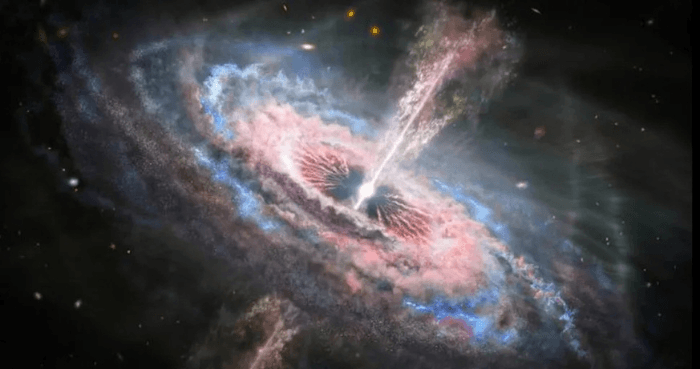
Astronomers have identified a distant quasar powered by a supermassive black hole that is emitting winds at a record-breaking 30% of the speed of light.
This wind, traveling at about 201 million miles per hour, is the fastest ever observed in ultraviolet wavelengths. The active galactic nucleus, called J2318, is located roughly 3 billion light-years away and has a mass of 1.7 billion times that of the sun.
While its mass is typical for a supermassive black hole, the extreme velocity of its outer winds is without precedent. Team leader Lucas Seaton from York University compared this atmospheric phenomenon to a “category 79 hurricane” to demonstrate its immense scale, emphasizing that such a cosmic gale is entirely unlike anything on Earth.
Unlike Earth’s winds, which are caused by atmospheric pressure, these cosmic winds are propelled by radiation. They happen when large disks of gas and dust encircle black holes. As the black hole consumes material, the disk experiences strong gravitational and tidal forces, making it emit bright radiation across various wavelengths. This radiation releases photons, particles of light, that drive matter outward from the disk at very high speeds.
The research team analyzed spectral data from the Sloan Digital Sky Survey, focusing on the SDSS-IV Time-Domain Spectroscopic Survey and the SDSS-V Black Hole Mapper. The spectra revealed high-velocity ultraviolet outflows, which are thought to be essential in galaxy evolution.
These extreme winds function as a vital link for galactic feedback, transferring energy from the active central region to the rest of the galaxy. This process can push away the raw gas and dust required for star formation, effectively halting star birth within the host galaxy.
The team’s findings were published in The Astrophysical Journal. While astronomers plan to continue hunting for high-speed ultraviolet outflows, they acknowledge that finding a wind faster than the one produced by J2318 will be a significant challenge.